
November 24th, 2026
Area
Guide
Rent
Living in Kokubunji, Tokyo: Special Rapid Trains, Cliff-Line Parks and the Rent Gap With Kichijoji
Last reviewed 24 Nov 2026 · 31 min read
Living in Kokubunji means trading a little polish for a lot of rent. You get a Chuo Line Special Rapid stop, about 20 minutes to Shinjuku, and a one-bedroom that costs roughly a third less than the same 1K in Kichijoji.
Kokubunji (国分寺) is a city of 131,127 residents in 66,380 households on the western side of Tokyo, not one of the 23 wards. The city publishes its figures in Japanese, like most of the official pages in this guide, and we have translated what matters.
This guide is written for people who will live here, not people passing through on a day trip. We cover what rent really looks like, how the trains behave at rush hour, what the police data says about bicycle theft, and where Japanese residents and English-language guides tell different stories.
The short version: Kokubunji suits renters who want Chuo Line speed without Kichijoji prices, students and young professionals, and couples who like parks and springs within walking distance. It does not suit anyone who wants a quiet station front after midnight, a flat commute or a big supermarket on every corner.
One note on the name. "Kokubunji" is the city, the main station and the neighborhood around it, while Nishi-Kokubunji (西国分寺) is a separate JR station about two kilometers west with its own quieter character. When we give resident and crime numbers, we mean the whole city. When we give rent or commute numbers, we say which station.
At a Glance Kokubunji, Tokyo City Kokubunji City (国分寺市), 131,127 residents in 66,380 households (1 Nov 2026) Train lines JR Chuo Line, Seibu Kokubunji Line, Seibu Tamako Line To Shinjuku About 20 minutes on the Chuo Special Rapid, about 30 on the Rapid To Tokyo Station About 38 minutes on the Chuo Special Rapid, no transfer Typical 1K rent About ¥53,900 Typical 2LDK rent About ¥124,700 Best for Renters who want Chuo Line access at a lower rent than Kichijoji or Mitaka, students, couples, people who like parks Not ideal for Light sleepers near the north exit, anyone who hates rush-hour crowding, families who need an international school at the door
Is Kokubunji a Good Place to Live?
Yes, if you want a fast Chuo Line commute at a lower price and you choose your block with the station crowds in mind.
Kokubunji gives you three train lines at one station, a Special Rapid that skips the slow stops, and rents that sit well under Kichijoji and Mitaka. A 1K averages ¥53,900 here against ¥79,300 in Kichijoji, a gap of about 32 percent.
What it does not give you is a calm station front at night. The north exit has a lively izakaya street, Japanese residents mention noise and drunk crowds more than any other complaint, and the police figures show the busiest streets are the ones beside the station.
Two things catch newcomers off guard. The first is how different the two sides of the station feel: shopping, towers and bars to the north, slopes and quiet housing to the south. The second is bicycles, because 251 of the 649 crimes recorded in the city in 2025 were bicycle thefts.
Kokubunji is a good place to live for anyone who treats the station as a commuting corridor and the streets beyond it as home.
Where Is Kokubunji?
Kokubunji sits in the middle of the Tama area of western Tokyo, about 20 minutes by Special Rapid from Shinjuku.
The city covers 11.46 square kilometers, measuring about 5.7 kilometers east to west and 3.9 kilometers north to south. It borders Kodaira, Tachikawa, Fuchu, Kunitachi and Koganei, which puts it in the middle of the western Tokyo suburbs.
With 131,127 residents on 1 November 2026, density works out to about 11,400 people per square kilometer (our arithmetic from the city's figures). That is a suburban city, but not a sleepy one.
The city counts 3,990 foreign residents in 2,475 households, about 3.0 percent of the population, up from 3,603 in January (the monthly table is a PDF on the city site). Tokyo as a whole has 783,701 foreign residents out of 14,077,552 people, or about 5.6 percent (PDF), so Kokubunji is less international than the capital average but growing quickly.
Our Kunitachi guide covers the quieter city just west of here, if you want to compare the two side by side.
Kokubunji is a mid-sized city at the center of the Chuo Line suburbs, close enough to Shinjuku to commute and far enough to afford a decent apartment.
What Kind of Place Is Kokubunji?
Kokubunji is a commuter city with a real station district, a university and a lot of water and green space hidden behind the apartment blocks.
Japanese area guides describe two faces. The north exit has the redeveloped station towers, a shopping complex and an izakaya street, while the south exit is quiet housing on sloping streets with a wooded cliff line behind it. Resident comments say the two sides feel like different places.
The English-language picture is flatter. Guides in English call Kokubunji peaceful, family-friendly and suburban, and none of the ones we read mention bicycle theft, night noise at the north exit or the slopes between the two sides.
That gap is the most useful thing to understand. Japanese residents describe what they deal with every day, while English guides describe what a visitor sees at noon on a Saturday.
Neither view is wrong, they are looking at different hours on the same streets.
Transport Access and Commute Times
Transport is the reason most people choose Kokubunji, and the Special Rapid is the reason it works.
Three lines meet here: the JR Chuo Line, the Seibu Kokubunji Line and the Seibu Tamako Line. The two Seibu lines start at Kokubunji, which Japanese housing editorials say gives riders a better chance of a seat.
The Chuo Special Rapid and Ome Special Rapid both stop at Kokubunji, as well as Rapid and Local services. Seibu's own station page lists its two lines, and we confirmed the Special Rapid and Ome Special Rapid stops in route-search data for 24 November 2026.
JR Kokubunji boarded 101,156 people a day in fiscal 2024, the 31st busiest station among JR East stations. Seibu reports 113,077 boardings plus alightings a day (PDF) for fiscal 2025 at its own Kokubunji station, and the two numbers measure different things, so you cannot add them together.
Commute Times from Kokubunji Station
The table uses typical times from Japanese route-search data. Treat each one as a typical weekday figure, not a promise, because waiting and walking vary.
| Destination | Train Line | Approx. Time | Why It Matters |
|---|---|---|---|
| Tachikawa | JR Chuo Rapid, no transfer | 8 minutes | West Tokyo's main hub |
| Kichijoji | JR Chuo Rapid, no transfer | 13 minutes | Shopping, Inokashira Park |
| Shinjuku | JR Chuo Special Rapid, no transfer | 19 to 21 minutes | Offices, Saikyo and Odakyu lines |
| Shinjuku | JR Chuo Rapid, no transfer | About 30 minutes | The slower service |
| Shibuya | Chuo Line, then Saikyo Line at Shinjuku | About 30 minutes, one transfer | Tech and retail hub |
| Ikebukuro | Chuo Line, then Saikyo Line at Shinjuku | About 31 minutes, one transfer | Saikyo Line, Tobu Tojo |
| Tokyo Station | JR Chuo Special Rapid, no transfer | About 38 minutes | Shinkansen, Marunouchi offices |
| Otemachi | Chuo Line, Tozai Line at Nakano | About 50 minutes, one transfer | Finance and head offices |
| Haneda Airport | Chuo Line, Shinagawa, Keikyu | About 1 hour 28 minutes, two transfers | Flights |
| Narita Airport | Via Shinjuku and Nippori | About 1 hour 44 minutes, two transfers | Flights |
Source: Japanese route-search snapshots taken between September and November 2026, each at a different time of day. Fares range from ¥210 to Kichijoji to ¥620 to Tokyo Station. The Narita fare is ¥3,200 and includes a Skyliner seat charge.
The Special Rapid is the detail that matters most. It saves about nine minutes to Shinjuku compared with the Rapid (our calculation from two departures in the same morning), and it is the reason Kokubunji commutes feel short.
Our guide to the best places to live along the JR Chuo Line compares every station on the line if you want to see where Kokubunji ranks.
Kokubunji's biggest practical advantage is that a rider gets from the suburbs to Shinjuku in about 20 minutes without a single transfer.
Rush Hour and Late Nights
The honest price of that speed is crowding.
The Ministry of Land, Infrastructure, Transport and Tourism measured the Chuo Line Rapid between Nakano and Shinjuku at 158 percent of capacity in fiscal 2025, carrying 65,330 people in the peak hour against a capacity of 41,440. The Tokyo-area average for the 31 measured sections is 143 percent, so the Chuo Line runs well above the capital's average.
Japanese resident reviews say the same thing more bluntly: the Chuo Line toward central Tokyo is the main stress of living here, and the reverse direction is much lighter. If your job starts after 10:00 or you can leave before 7:30, the problem shrinks considerably.
At night, route-search data shows the last direct train to Shinjuku leaving Kokubunji at 23:45 and arriving at 00:14. The first train to Shinjuku leaves about 04:40.
Anyone who can shift their commute by half an hour will like Kokubunji far more than someone locked into the 8:00 peak.
Getting to Haneda and Narita
Airports are workable, but neither is quick.
Haneda takes about 1 hour 28 minutes with two transfers, via Shinjuku, Shinagawa and the Keikyu Line. Narita takes about 1 hour 44 minutes with two transfers via Shinjuku and Nippori, and a Skyliner seat adds to the fare.
If you fly often, a taxi or airport limousine bus is worth pricing before you sign a lease. We could not confirm an airport bus from Kokubunji on an official page, so we are not naming one.
Kokubunji is a long way from both airports, and that is the cost of living in the western suburbs.
Buses, Bicycles and the Station District
The city runs a community bus called Bunbus on six routes, and it costs a flat ¥200 for adults. The city page, updated 11 June 2026, says Suica and PASMO work on five of the six routes, not the Kitamachi route.
Bicycles carry real weight here. The city lists municipal bicycle parking with 3,146 spaces at the north exit, 3,066 short-term spaces in the north exit underground lot and 1,271 at the south exit, with about 3,500 more at Nishi-Kokubunji. Short-term parking is ¥100 a day and monthly passes run ¥1,000 to ¥2,400 depending on the lot (the city's fee page was last updated 1 April 2025, so confirm current prices).
The north exit changed shape in the last decade. The urban redevelopment project (PDF) behind the station finished its main buildings on 30 March 2018, producing two towers of 35 and 36 floors, and the city's own redevelopment page records the "cocobunji" naming and project history.
Buses and bicycles fill the gaps the trains leave, and beyond the station area a bicycle is closer to a requirement than a luxury.
Rent in Kokubunji
Rent is the strongest argument for Kokubunji, and the numbers are easy to read.
The table below uses average asking rents for the Kokubunji Station area from Japanese rental market data, a rolling three-month average of listings read in November 2026. Layouts are in ascending order.
| Layout | Average Rent (per month) | Best For |
|---|---|---|
| 1R (ワンルーム) | ~¥48,300 | Students and singles on a tight budget |
| 1K | ~¥53,900 | Singles who want a separate kitchen |
| 1DK | ~¥70,200 | Singles who want a dining space |
| 2K | ~¥72,000 | Sharers or couples on a budget |
| 1LDK | ~¥93,800 | Couples, or singles who work from home |
| 2DK | ~¥96,200 | Couples who want two rooms |
| 2LDK | ~¥124,700 | Couples with a child, or a home office |
| 3LDK | ~¥159,800 | Families |
Source: Japanese rental market data, rolling three-month average of listings, read in November 2026. The data source does not print an exact month and we could not find a second portal for a cross-check, so treat these as typical averages rather than fixed ceilings. The 3LDK figure rests on a small number of listings.
The relative position matters more than any single number. A Kokubunji 1K at ¥53,900 sits about 32 percent below Kichijoji (¥79,300), about 29 percent below Mitaka (¥76,100) and about 43 percent below Nakano (¥94,600), based on the same data source and period.
Nishi-Kokubunji is almost identical: ¥54,300 for a 1K and ¥124,500 for a 2LDK. The difference there is the train, since Special Rapid services do not stop at Nishi-Kokubunji.
The cheapest comparison on the Chuo corridor is Kodaira, which is cheaper on 1LDK and 2LDK but sits on a Seibu line rather than the Chuo Line. We put all the neighbors side by side in the comparison section.
We could not find rent averages broken down by exit, walk distance or building age, so we cannot say how much the south exit's slopes or the north exit's towers move the price. Newer tower apartments near the station will cost more than these averages, and older buildings a ten-minute walk away will cost less.
Kokubunji's rent advantage over Kichijoji is large enough to pay for a better apartment.
Move-In Costs
Rent is only part of the cost of getting into an apartment in Japan.
The items are standard across Tokyo: a refundable deposit (shikikin, 敷金), a gift to the landlord (reikin, 礼金), an agency fee, a fee to a guarantor company, fire insurance and a key exchange charge. Conventions vary, and many properties now advertise no key money at all.
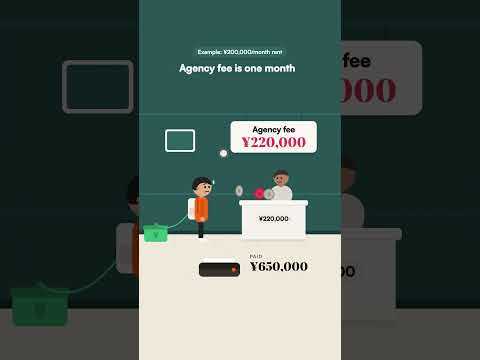
The agency fee is capped by law at one month of rent plus consumption tax, and the guarantor company charges an initial fee of about half a month to one month of rent, with a small monthly fee after that. Fire insurance usually runs ¥10,000 to ¥20,000, and key exchange about ¥15,000 to ¥20,000 (typical conventions from Japanese rental guides, which vary by landlord).
The Tokyo Metropolitan Government's rental housing guideline (PDF) adds two points worth knowing. The landlord normally pays for key replacement when keys have not been lost or damaged, and a "no deposit" listing can still charge restoration costs when you leave.
Here is a worked example for the average Kokubunji 1K, assuming a move-in on the first of the month. It is an illustration, not a quote.
- Deposit (1 month): ¥53,900
- Key money (1 month): ¥53,900
- Agency fee (1 month plus 10 percent tax): ¥59,290
- Guarantor company initial fee (half a month): ¥26,950
- Fire insurance (two years, mid-range): ¥15,000
- Key exchange: ¥20,000
- First month's rent: ¥53,900
- Total: about ¥282,940, or roughly 5.2 months of rent
A listing with no key money drops the total by ¥53,900, and a listing with no deposit lowers the cash you hand over on day one while leaving the restoration bill for the end of the lease.
For a line-by-line breakdown of every fee, our guide to the essential fees to budget for when renting in Japan covers each one with examples.
Budget about five to six months of rent in cash before you sign anything, and ask the agent for the full initial-cost estimate in writing.
Renting in Kokubunji as a Foreign Resident
Foreigners rent in Kokubunji every day, and the process is the one you would follow anywhere in Tokyo.
Landlords and guarantor companies look at your visa, your income, your employer and your Japanese ability. A guarantor company is what stands in for a Japanese co-signer, and our guide on why guarantor companies exist in Japan explains how screening works.
How hard your search is depends heavily on visa type. Our guide to renting in Tokyo on your visa breaks down what landlords accept for work visas, student visas, working holidays and newer categories.
Tokyo Keizai University has a campus in Kokubunji, 12 minutes on foot from the south exit according to the university. That makes the south side a natural base for students and young renters.
At E-Housing, we work with foreign residents across greater Tokyo every day, and the Chuo Line suburbs reward renters who start early. Japan's moving season peaks in March and April, so start looking at least two months before your move date.
If you want help finding a Kokubunji apartment with a landlord who accepts foreign tenants, our English-speaking team can search listings, handle the application and explain the contract line by line.
Renting in Kokubunji is straightforward once you know the fees, the screening and the right time to start.
Share Houses and Furnished Rooms
Share houses are a visible part of the Kokubunji market.
Search data shows English-language interest in Kokubunji share houses, and the results are full of share-house and furnished-apartment operators. We could not find a count of share-house rooms in the city on any official page, so we cannot say how large this part of the market is.
For the general rules on how share houses work, what they cost and who they suit, see our share house guide for foreigners. Always read the house rules and the exit conditions before you sign, because share-house contracts differ from standard leases.
A share house can solve a short-stay problem in Kokubunji, but it is no substitute for a standard lease if you plan to stay for years.
Supermarkets and Daily Shopping
Daily shopping is easy at the station and thinner as you walk away from it.
Most of the food shops sit within about 100 meters of Kokubunji Station in a straight line, based on listings from a Japanese flyer and shopping service. Seiyu and Maruetsu (south exit) are the nearest full supermarkets, and OK Store, a discount supermarket, is about 500 meters away.
Seijo Ishii, Queen's Isetan and Kaldi sit inside the station buildings, which suits shoppers who want better produce and imported food on the way home. Cereo is the JR East station building on the south side, and it was still holding events in August 2025 according to JR East.
The north exit has the cocobunji towers. Meets Kokubunji, a retail complex run by Mitsukoshi Isetan, takes the lower floors of the west tower, and a plaza on the fifth floor holds a hall, a cafe and a city service counter (the 2022 account of the project comes from a developer-side editorial, so we have left it unlinked).
Five drugstore chains sit around the station: Matsumoto Kiyoshi, Welcia, Sugi, Cocokara Fine and Sun Drug. We could not confirm a named 100-yen shop at the station itself.
Nishi-Kokubunji is quieter. Tobu Store and OK Store are both within a few hundred meters, and Japanese residents say supermarkets there close earlier and the streets are darker at night.
Seiyu is sometimes described as open 24 hours, but sources conflict, so check the store's own hours before you rely on late-night shopping.
Daily errands are painless around the station and less convenient the further you walk from it.
Food and Local Character
Kokubunji's food scene is local, small and a little bookish.
The most useful local fact is Kokuvege (こくベジ), the city's farm-produce brand. A Tokyo tourism foundation case study (PDF) says about 100 restaurants take part, and farmers sell vegetables at direct-sales stands around the city.
Kokubunji also has a jazz-and-literature story. Haruki Murakami opened a jazz café-bar called Peter Cat in Kokubunji in 1974, according to his publisher's timeline, and it later moved to Sendagaya. Waseda University's Murakami Library says nothing of the original bar survives, so this is history, not a place to visit.
Honyarado (ほんやら洞), a cafe-bar founded in 1975, is listed as open about three minutes from the south exit. We have not named other bars or ramen shops, because we could only verify places through listing pages and a name that closes next month does readers no favors.
The north exit is where the evening life lives. Japanese resident comments describe a lively izakaya street, drunk crowds late at night and taxi queues after the last train, so the area suits people who enjoy that energy and bothers light sleepers.
The south exit is the opposite. It is quiet, residential and, some residents say, dark and narrow after nightfall.
Eating out in Kokubunji is local rather than famous, and you will find the best of it with a few visits instead of one list.
Parks and Green Space
Parks are Kokubunji's quiet strength, and they sit within walking distance of both stations.
Tonogayato Garden (殿ヶ谷戸庭園) is a national scenic garden built around a former villa and known for its autumn maples. GOTOKYO lists it two minutes on foot from Kokubunji Station, open from 9:00 to 17:00.
Musashi-Kokubunji Park is a Tokyo metropolitan park of 11.46 hectares that opened in 2002, with forest along the cliff line and a pond. The Kokubunji Festival is held there, and the 43rd edition ran on 1 November 2026 with the park listed as seven minutes from Nishi-Kokubunji and ten from Kokubunji.
South of the station, the Otaka-no-Michi path follows spring water. It is part of the Environment Ministry's "100 famous waters" listing, and the same page puts it 16 minutes on foot from the Nishi-Kokubunji south exit.
History is part of the green space too. The Musashi Kokubunji Site Museum sits on the grounds of the ancient provincial temple, open 9:00 to 17:00 and closed Mondays, about 15 minutes from Nishi-Kokubunji and 20 from Kokubunji on foot.
Koganei Park, a very large metropolitan park, is next door in Koganei. We could not verify a walking or bus route from Kokubunji on an official page, so check a route before planning a trip there.
Kokubunji lets you walk from your front door to a garden, a spring or a forest path in under 20 minutes.
Safety and Everyday Crime
Kokubunji is a low-crime city by Tokyo standards, and the one crime that shapes daily life is bicycle theft.
The Tokyo Metropolitan Police Department recorded 649 penal-code offenses in Kokubunji in 2025, and it marks the figures as provisional. Non-burglary theft made up 434 of them (66.9 percent), and bicycle theft alone was 251 (38.7 percent), followed by 79 shoplifting cases.
Serious crime is rare. The same table lists 8 violent offenses of the most serious kind, no robberies and 25 break-in thefts, 9 of them home burglaries while residents were out.
Divided by the city's January 2026 population of 130,076, 649 offenses works out to about 5.0 per 1,000 residents. Tokyo's total of 99,349 offenses in 2025 divided by 14,077,552 residents gives about 7.1 per 1,000 (both rates are our arithmetic, and the two populations are January 2026 snapshots, not mid-2025 averages). We did not source a 23-ward or Tama-area average, so we make no comparison with either.
The block-by-block counts show where it happens. Honcho 2-chome had 84 offenses and Honcho 3-chome 50, both on the north side of Kokubunji Station, and Minami-cho 3-chome had 55, 44 of them non-burglary theft on the south side. No other chome passed 33. These are counts, not rates, and the busiest areas are the ones with the most people passing through.
The city's crime-prevention page names burglary, special fraud aimed at older people and bicycle theft as its main concerns, and says bicycle theft happens widely around stations.
That makes a lock and insurance sensible. Use two locks on a good bicycle and read our guide to bicycle insurance in Japan, because insurance is now required for riders in Tokyo.
Japanese residents say the area is reasonably safe in daylight and uneasy for some on narrow, dark streets away from the station at night. That is a feeling, not a measurement, and the police table does not contradict it.
For a wider picture, our guide to the safest and most dangerous places to live in Tokyo shows where Tokyo's neighborhoods stand.
Kokubunji is safe enough that the main security task is protecting your bicycle.
Disaster Risk and the Hazard Map
Kokubunji sits on solid upland ground, and the main hazards are river flooding in the lowest areas and landslides on the cliff-line slopes.
The city revised its hazard map in March 2026 and delivered it to every household. There is no English version, so use a translation tool on the city's page and look up your exact address before you sign a lease. We could not read the map PDF's flood depths or shaking intensities because its text is not machine-readable, so we are not quoting any.
Landslide warning zones cover parts of Nishimotocho 2, Higashimotocho 3, Minami-cho 2 and 3, Izumi-cho 1, Honcho 1, Hiyoshi-cho 2 and Naito 2, and the stricter special warning zones cover parts of Nishimotocho 2, Izumi-cho 1, Higashimotocho 3 and Honcho 1 on the city's hazard information page. The same page says parts of the city may be at risk of liquefaction without naming areas.
Kokubunji is one of nine municipalities covered by the Tokyo Metropolitan Government's flood assumption map for the Nogawa and neighboring rivers, designated on 15 February 2024. The scenario assumes maximum-scale rain of 153 millimeters an hour and 690 millimeters over 24 hours.
For earthquakes, the Tokyo Metropolitan Government's ninth regional risk survey (September 2022) classes all 70 Kokubunji chome as upland ground. By our count from the open data file, 30 chome rank 1 for overall danger (the lowest), 32 rank 2, 7 rank 3 and 1 ranks 4 (Shinmachi 2-chome), with none in the top rank of 5.
The nearby Tachikawa Fault Zone is about 33 kilometers long and is expected to produce a magnitude 7.4 earthquake, with a 30-year probability of 0.5 to 2 percent according to the government's earthquake research committee. That page does not name Kokubunji, and we could not find a verified shaking forecast for the city.
Our guide to flood-safe areas of Tokyo explains how to read these maps when you compare neighborhoods.
Kokubunji's hazard profile is moderate, and a ten-minute check of your exact address tells you more than any city-wide average.
Healthcare in Kokubunji
Healthcare is available, but English support is the gap.
We could not find a Kokubunji clinic that states English support on its own page. The one Kokubunji entry on Tokyo's list of institutions designated to accept foreign patients (undated) is Nomura Clinic Square in Honda 1-chome, and the list does not say which languages it supports. Kokubunji Hospital appears in a Tokyo health directory, with no bed count and no English support listed.
For holiday and night emergencies, the city runs a rotating clinic system, and its page on holiday emergency care is in Japanese only.
If you need an English-speaking doctor, call ahead and ask directly. Our guide to English-speaking doctors in Tokyo lists clinics across the city.
Plan your doctor before you need one, because Kokubunji's English-language care is thinner than central Tokyo's.
Schools and Families
Kokubunji works well for families who use the Japanese public school system and less well for families who need an international school nearby.
The city lists 10 municipal elementary schools and 5 junior high schools. Foreign children enroll by submitting a notice of school attendance for foreign nationals to the city's School Affairs Section, and the city's page on foreign-national pupils links easy-Japanese guides and a seven-language guide from the Ministry of Education. The page does not describe in-school Japanese classes.
Childcare looks manageable. Tokyo's August 2026 childcare table shows 7 children on the Kokubunji waiting list on 1 April 2026, down from 9 a year earlier, with 3,535 of 5,656 preschool-age children (62.5 percent) in childcare. After-school clubs had no waiting list on 1 May 2025 according to the Tokyo welfare bureau.
We could not verify an international school inside Kokubunji. Nearby, Global Step Academy International School Tachikawa takes children aged 1.5 to 6, and Tokyo West International School is in Hachioji.
Our guides to the Japanese education system for foreign families and childcare options for foreign families in Tokyo cover the details by age.
Families who choose Japanese schools will find Kokubunji easy, and families who need an English-language curriculum will commute.
Moving In: City Hall and Registration
Registering your address is a legal step, and Kokubunji's rules are clear.
You must file a move-in notice within 14 days at the Citizens' Section on the first floor of city hall, and bring your residence card for every foreign household member. The city's moving-in page says the cocobunji and Kunitachi-station service corners cannot take this filing.
City hall is in Izumi-cho, about a ten-minute walk from Nishi-Kokubunji Station according to the city's access page. That page also says office hours will shorten from February 2027, and the new hours are in a PDF we could not read, so check before you go.
A Saturday counter opens on the second Saturday of each month from 9:00 to 12:00, except in April and August, but moves from overseas must be filed on a weekday according to the city's holiday counter page.
The city's foreign-resident page links English and Chinese sections, though the English section is mostly news items and we found no full English life guide. A consultation page for foreign residents exists but lists no languages or hours, so call before you assume a translator will be available.
Allow a weekday morning for registration and bring every household member's residence card.
Best Areas Within Kokubunji
Kokubunji divides into three living areas, and each suits a different person.
The north exit (Honcho and the station towers). This is the busy side, with the cocobunji towers, a shopping complex, a bus terminal and the izakaya street. Rents run higher in the newer buildings, and the area suits people who want everything at the door and accept noise at night.
The south exit (Minami-cho and Nishimotocho). The south is quieter and residential, with slopes, the cliff line and the springs. Japanese guides call Kokubunji family-friendly, and the quiet housing here is the reason, though residents say pavements are narrow and the streets darker at night.
Nishi-Kokubunji. This station is quieter than Kokubunji, with less nightlife and similar rents. The trade-off is that Special Rapid services do not stop there, and city hall is a ten-minute walk away.
A viewing at 9:00 on a Saturday night will show you a different neighborhood from a viewing at noon, so see the street at both times.
Pick your exit before you pick your apartment, because the two sides of Kokubunji are different places.
Pros and Cons of Living in Kokubunji
The honest case for Kokubunji is built on rent, trains and green space, and it is weakened by crowding, night noise and bicycle theft.
Pros
- Chuo Special Rapid and Ome Special Rapid stops, about 20 minutes to Shinjuku with no transfer.
- Rent about 30 percent below Kichijoji and Mitaka for the same layout.
- Two Seibu lines that begin here, which Japanese editorials say improves your chance of a seat.
- Tonogayato Garden, Musashi-Kokubunji Park and the springs within a short walk.
- A low recorded crime rate, about 5.0 offenses per 1,000 residents.
- A daycare waiting list of only 7 children on 1 April 2026.
- Tokyo Keizai University in the city, a draw for student renters.
Cons
- The Chuo Line Rapid runs at 158 percent of capacity at peak, well above the Tokyo-area average of 143 percent.
- Bicycle theft is the biggest crime category, at 251 cases in 2025.
- The north exit is noisy at night, and Japanese residents mention drunk crowds and taxi queues.
- Slopes and level differences around the south exit make cycling hard.
- No international school in the city and little verified English-language healthcare.
- No official English hazard map.
A list like this only helps if you weigh it against your own routine.
Who Should Live in Kokubunji
Kokubunji is for people who want Chuo Line speed and are willing to plan around it.
It suits renters who work in Shinjuku, Tokyo Station or Tachikawa and want a lower rent than Kichijoji. It suits students at Tokyo Keizai University, couples who like parks and slow weekends, and remote workers who commute only a few days a week.
It also suits people who prefer a station-centered life. If you shop, eat and meet friends within a few hundred meters of the station, you will use Kokubunji's strongest side.
Kokubunji rewards people who value time and rent more than prestige.
Who May Not Like Kokubunji
Kokubunji is a poor fit for three kinds of renter.
If you cannot leave before 7:30 or after 10:00, the Chuo Line at 158 percent of capacity will wear on you. If you want a wide choice of English-language services, a big international community or a strong nightlife that is not a street of izakaya, central Tokyo does it better.
Families who need an international school close to home will also struggle. Tachikawa and Hachioji are the nearest options we could verify, and neither is a short walk.
If your priorities are a short commute and a quiet night, look at a different station before you commit.
Kokubunji vs Kunitachi, Kichijoji, Tachikawa and Koganei
Kokubunji's neighbors differ more in price and character than in distance.
| Area | Average 1K Rent | Average 2LDK Rent | Character | Best For |
|---|---|---|---|---|
| Kokubunji | ~¥53,900 | ~¥124,700 | Commuter city with Special Rapid, parks and a lively north exit | Value seekers, students, couples |
| Kunitachi | ~¥55,800 | ~¥125,600 | Planned education town, tree-lined Daigaku-dori | Quiet-seekers who accept a slower train |
| Kichijoji | ~¥79,300 | ~¥178,400 | Lively mix of nature, crowds and culture | Renters who want the famous address |
| Mitaka | ~¥76,100 | ~¥172,600 | City and suburb in one, calmer than Kichijoji | Renters who want Kichijoji's side of the line |
| Tachikawa | ~¥69,600 | ~¥134,000 | West Tokyo's transport hub with department stores | Renters who want big-city shopping |
| Musashi-Koganei | ~¥58,600 | ~¥134,600 | University and park town | Students and park lovers |
Source: Japanese rental market data, rolling three-month average of listings, read in November 2026, for each station named. Character notes come from Japanese area guides and our own neighborhood guides.
Kunitachi is a planned education town built around Hitotsubashi University and Daigaku-dori, and it is quieter than Kokubunji with thinner nightlife. The Special Rapid does not stop there, and our Kunitachi guide is the one to read if you want that calm.
Kichijoji is the famous one, and its rent shows it. Its 1K costs about ¥25,400 more than Kokubunji's, and our Kichijoji guide shows what that buys.
Mitaka is next to Kichijoji and calmer, with an average 1K near ¥76,100 according to the same data. Our Mitaka guide covers the city.
Tachikawa is the transport hub of western Tokyo, with Lumine, Isetan and Takashimaya department stores and Showa Kinen Park. It is eight minutes from Kokubunji by Rapid, and our Tachikawa guide covers it.
Koganei is a university-and-park town, with Koganei Park and three universities according to a Japanese area guide, and its Musashi-Koganei station costs about ¥4,700 more than Kokubunji on a 1K.
Kokubunji sits at the cheap end of the Chuo Line corridor with a Special Rapid stop that Kunitachi lacks.
Practical Advice from E-Housing
A few habits make a Kokubunji move easier.
Choose the exit before the apartment. Walk both sides at 7:00 in the evening, because the north exit at dusk and the south exit at dusk are not the same neighborhood.
Time the commute yourself. Ride the Chuo Line Rapid to Shinjuku at your actual commute hour once before you sign, and decide if 158 percent of capacity is acceptable.
Ask about the hazard map. The city's hazard map is in Japanese, so ask your agent to check the landslide and flood zones for the exact address.
Check bicycle parking. If the building has no bicycle space, the municipal lots near the station list 3,146 spaces at the north exit, but a monthly pass is separate.
Start early. If you plan a move in March or April, begin your search two months ahead.
At E-Housing, we work with foreigners, expat families, international students and working professionals across greater Tokyo every day. We can search Kokubunji and Nishi-Kokubunji listings for landlords who welcome foreign tenants, walk you through the contract in English and check the practical points above before you sign.
A well-prepared renter in Kokubunji can save thousands of yen a month and still reach Shinjuku in 20 minutes.
Final Verdict: Should You Live in Kokubunji?
Yes, if rent and a fast Chuo Line commute matter more to you than a quiet station front and a famous address.
Kokubunji gives you about 20 minutes to Shinjuku, parks within a short walk and rent that sits about a third below Kichijoji. In exchange you accept crowded morning trains, a bicycle you need to protect and a north exit that gets loud.
We think it is one of the better-value stations on the Chuo Line for renters who can work around the peak. It is a weaker choice for anyone who needs English-language services or an international school at the door.
If you are weighing Kokubunji against Kichijoji, the question is whether you would rather spend the rent difference on a bigger apartment or on the address. Most people we talk to find the bigger apartment.
Kokubunji will not impress anyone with its name, and it will impress you every month when the rent comes out.
FAQ: Living in Kokubunji, Tokyo
Is Kokubunji a good place to live?
Yes, for renters who want a fast Chuo Line commute at a lower price than Kichijoji. It has a Special Rapid stop, large parks and a low recorded crime rate, and the trade-offs are crowded morning trains and a noisy north exit.
Is Kokubunji in a ward?
No. Kokubunji is a city (国分寺市) in western Tokyo, not one of the 23 special wards. It borders Kodaira, Tachikawa, Fuchu, Kunitachi and Koganei.
What line is Kokubunji Station on?
The JR Chuo Line, the Seibu Kokubunji Line and the Seibu Tamako Line all serve it. The Chuo Special Rapid and Ome Special Rapid stop here as well as Rapid and Local services.
How long does it take to get from Kokubunji to Shinjuku?
About 20 minutes on the Chuo Special Rapid and about 30 minutes on the Rapid, with no transfer. The first train to Shinjuku leaves around 04:40 and the last direct train leaves at 23:45.
How long does it take to get from Kokubunji to Tokyo Station?
About 38 minutes on the Chuo Special Rapid with no transfer, and the fare is ¥620.
How do you get from Haneda Airport to Kokubunji Station?
Take the Keikyu Line to Shinagawa, then the Yamanote Line to Shinjuku and the Chuo Line to Kokubunji. Route search gives about 1 hour 28 minutes with two transfers.
Is Kokubunji safe?
Yes. Police recorded 649 offenses in 2025, about 5.0 per 1,000 residents, and most were bicycle theft and other theft. Violent crime was rare, with 8 serious violent offenses and no robberies.
How much is rent in Kokubunji?
A 1K averages about ¥53,900 a month, a 1LDK about ¥93,800 and a 2LDK about ¥124,700, according to Japanese rental market data. Newer buildings near the station cost more.
Is Kokubunji cheaper than Kichijoji?
Yes. A 1K in Kokubunji costs about 32 percent less than in Kichijoji, and a 2LDK about 30 percent less. Both stations are on the Chuo Line, about 13 minutes apart by Rapid.
What is the difference between the north and south exits of Kokubunji Station?
The north exit has the cocobunji towers, shops, a bus terminal and an izakaya street, and it is busy and loud at night. The south exit is quieter and residential with slopes and the cliff line behind it, and residents describe the streets as darker after nightfall.
Is Nishi-Kokubunji better than Kokubunji?
It depends on what you want. Nishi-Kokubunji is quieter and has similar rent (about ¥54,300 for a 1K), but Special Rapid trains do not stop there.
Does Kokubunji have an international school?
We could not verify one inside the city. Global Step Academy International School Tachikawa (ages 1.5 to 6) and Tokyo West International School in Hachioji are the nearest we could confirm.
Does Kokubunji flood?
Parts of the city are in the Nogawa and neighboring rivers' flood assumption area, and parts of the cliff line are landslide zones. Check your exact address on the city's hazard map before you sign a lease.
What is there to do in Kokubunji?
Visit Tonogayato Garden, walk the Otaka-no-Michi spring path, spend an afternoon in Musashi-Kokubunji Park and see the ancient temple ruins and site museum. The city also runs a Kokubunji Festival each autumn.
Can foreigners rent in Kokubunji without a Japanese guarantor?
Yes, usually through a guarantor company, which replaces the Japanese co-signer for a fee of about half to one month of rent. Landlords still screen visa, income and employer, so start early.
Are there share houses in Kokubunji?
Yes, there are share-house and furnished-room operators in the area. We could not find an official count, so ask for current listings and read the contract carefully.
Kokubunji is a better fit than most people expect, and a few viewings will tell you if it fits you.
Share article
Get In Touch
Let’s Connect! How Can We Assist?
E-Housing connects you with quality properties across Tokyo. Whether you’re renting, buying or selling, our experts are ready to help. Fill out the form below for a response within 24 hours.